Immersive technologies are transforming how we work, learn, and communicate, from supporting surgeons with precise visualizations to creating inclusive, emotionally rich digital experiences. The HCID/XR program prepares you to design and develop sustainable, accessible, and innovative interactive systems for domains such as healthcare, education, culture, and entertainment. You will gain hands-on experience with state-of-the-art tools and collaborate on projects that combine human, technical, and business perspectives.
As interaction moves beyond screens to gestures, speech, gaze, and spatial input, the program emphasizes designing for users’ social and cognitive behavior in real contexts. Depending on your chosen pathway, you may specialize in areas such as AI-driven XR applications, multi-sensory design, adaptive systems, or advanced visualization. Graduates are equipped to become innovators and leaders in the XR field, shaping immersive systems that are inclusive, efficient, and grounded in human experience.
The study pathway is interdisciplinary with courses on design and evaluation of interactive systems and a strong emphasis on user-centred design techniques. It also embeds a set of courses on Innovation & Entrepreneuship, as part of the I&E Minor in common with all the other 28DIGITAL Master School study tracks.

This programme is developed and co-funded through the European Union’s Digital Europe Programme Project “ARISE” under Grant Agreement no. 101225600, which grants scholarships and financial support to top-ranked students.
First-year program at POLIMI
Admission requirements
The HCID major is a study track within the Polimi’s degree programme in Computer Science and Engineering (M.Sc.). Therefore, this entry university is best suited for applicants with a bachelor degree in Computer Engineering (or equivalent programmes). We require a strong base of ICT, computer science, programming, software engineering and databases, alongside engineering subjects (e.g. electronics, automatic controls or mechanics), physics, probability and statistics, linear algebra and mathematical analysis courses in your transcript of records.
Politecnico di Milano is a vibrant crossroads of cultures where design, architecture, and art meet technical, scientific, and engineering disciplines. The university offers a highly qualified entry-point for the Human-Computer Interaction and Design master’s programme, built on the synergy between the School of Design and the School of Industrial and Information Engineering. These institutions have a long-standing tradition of excellence in multidisciplinary education, cutting-edge research, collaboration with industry, and innovation. According to the QS World University Rankings 2025 by Subject, Politecnico di Milano ranks 1st in Italy, 6th worldwide in Design, and 21th worldwide in Engineering and Technology.
Multidisciplinary context

I3Lab is a multidisciplinary research group, led by Franca Garzotto, including students from the Master and Doctoral Schools, Research Assistants, and external consultants, with heterogeneous backgrounds – software engineering, human-computer interaction, psychology, and design. One of the aims is to focus on children with special needs, in order to promote social, emotional and intellectual benefits.
Hint Lab, led by Maristella Matera, focuses on human-centred processes for the design of interactive technologies, empowering users to effectively control and interact with computing systems across different domains, improving the accessibility, inclusivity and transparency of technology. We address HCI methods that pose the final user at the center of the entire development process, by providing design frameworks for interactive systems that exploit Smart Environments, Conversational AI, and IoT.

The first-year program of HCID at Polimi provides 60 ECTS. It includes a technical common base in Computer Science and Engineering, with a focus on Human-Computer Interaction (36 ECTS); the Innovation & Entrepreneurship Minor (20 ECTS), and a thematic I&E Summer School (4 ECTS).
The following table summarises the study plan at Polimi. Based on the curriculum of previous studies and the coursework that will be offered by the assigned exit university, the Admission Committee at Polimi may specify some directions in the individual study plans for the first year.
| First Semester | ECTS | Second Semester |
|---|---|---|
| Technical Major – mandatory courses (26 ECTS) | ||
| Advanced User Interfaces | 6 | |
| Software Engineering II | 5 | |
| Systems and Methods for Big and Unstructured Data | 5 | |
| 5 | Computing Infrastructures | |
| 5 | Multimodal Interactive Technologies and Applications | |
| Technical Major – HCI electives (10 ECTS – make 2 choices) | ||
| Design and Implementation of Mobile Applications | 5 | |
| Videogame Design and Programming | 5 | |
| Foundations of Artificial Intelligence | 5 | |
| Recommender Systems | 5 | |
| Multidisciplinary Project | 5 | Multidisciplinary Project |
| 5 | Interaction Design Studio | |
| 5 | Robotics and Design | |
| 5 | Process and Service Design | |
| 5 | Machine Learning | |
| 5 | Philosophical Issues of Computer Science | |
| 5 | Computer Graphics | |
| I&E Minor – mandatory courses (24 ECTS) | ||
| I&E Basics (5 ECTS, 1 choice) | ||
| High-Tech Startups: creating and scaling up | 5 | |
| 5 | High-Tech Entrepreneurship | |
| 5 | Digital Business | |
| I&E Business Development Lab (10 ECTS) | ||
| 10 | Digital Business Lab | |
| I&E complementary skills (5 ECTS) | ||
| 5 | Inclusive Digital Technologies | |
| I&E Summer School (4 ECTS, in the Summer) (*) | ||
(*) The Summer School takes place between the first and second year, being counted among the 60 ECTS of the first year. It brings students together for two weeks to work in groups on a business modelling and planning project in the context of a societally relevant thematic area. Summer Schools take place at different locations throughout Europe, supporting a multidisciplinary and international dimension, with a clear 28DIGITAL flavour to education. You can choose the one you like to attend from the catalogue of Summer Schools organised by 28DIGITAL.
Detailed descriptions for Polimi courses on our Manifesto degli Studi
Second year abroad
During the second year, students can specialise in one of the technical areas offered by their respective Exit Universities, completing 30 ECTS of exams and 30 ECTS for the Thesis. Please, refer to their local programs for the second year study plans described on the 28DIGITAL Master School webpage for Human-Computer Interaction & Design.


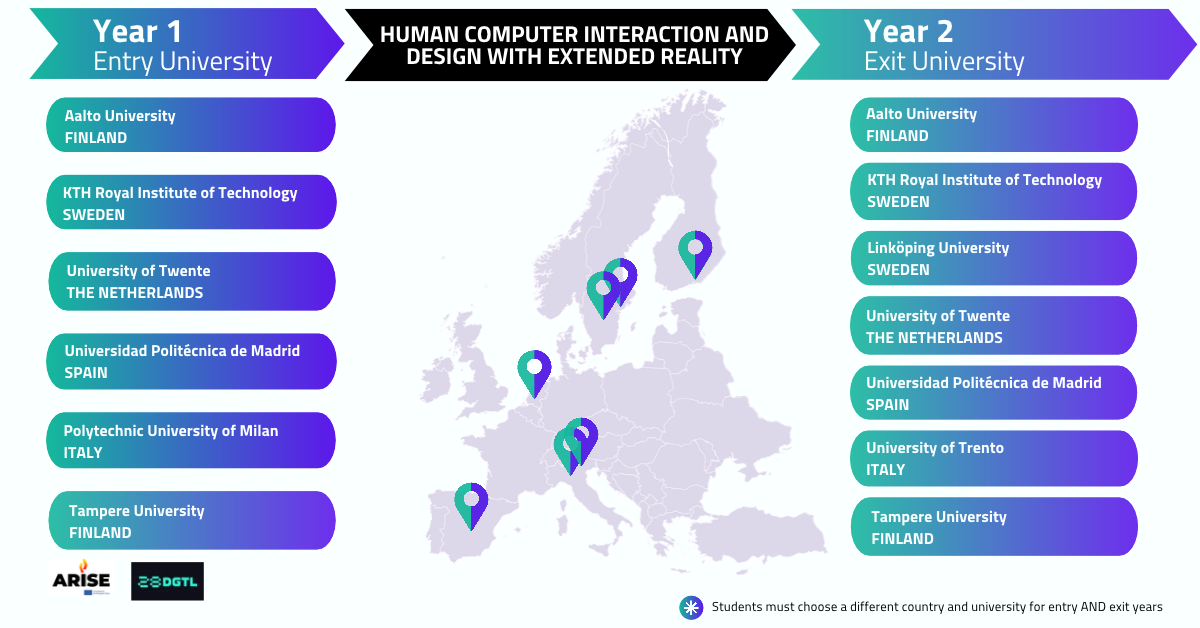
Double Degree
At the end of the programme, a Master degree will be awarded by both universities involved in the mobility pathway (namely, the Laurea Magistrale in Computer Science and Engineering by Polimi and another MSc degree by your exit university). Moreover, you will receive an “EIT label” certificate, which attests to the Innovation and Entrepreneurship skills acquired during the programme.
EIT label: a seal of quality for entrepreneurial education
The EIT Label, granted by the European Institute of Innovation and Technology (EIT), recognises education programmes that develop practical skills in innovation and entrepreneurship, preparing students to address real-world challenges. Courses that bear our EIT Label are all guaranteed to make sure you’re getting hands-on experience across Europe that directly prepares you for your chosen sector and connects you to the like-minded people ready to help get your ideas off the ground.
Contacts

Maristella Matera
HCID & ARISE Coordinator at Polimi